Learn more about
Products
Best Practice Solutions for the Municipal Security Lifecycle
MuniREF
Municipal Reference Data Built for Accuracy and Cost Efficiency
For established institutional users, Fintech and Regtech startups
MuniREF provides municipal bond terms, schedules, identifiers, and disclosure events in a structured format for security master databases. It is also a cost-efficient model designed to meet Fintech and Regtech startups’ need for affordable, reliable data.
MuniREF, jointly powered by DPC DATA and FTLabs’ DataLattice.ai, combines AI-driven data extraction with human municipal bond expertise. It prioritizes accurate data, keeps costs in check, and offers flexibility in how you receive the data to match your system requirements.
DPC DATA brings its deep municipal data expertise, extensive municipal disclosure library, and market relationships. These capabilities inform how municipal terms, structures, and events are interpreted and organized.
FTLabs’ DataLattice.ai provides the underlying AI-powered document intelligence framework for MuniREF. It transforms information embedded in complex, inconsistently formatted documents into structured, machine-readable data with traceability to original source documents.
Whether you want to compare a second source, assess an alternative to your current provider, or build a new application, MuniREF puts data quality, cost efficiency, and delivery flexibility at the center of your strategy.
Key benefits
The bond details your workflows require. The data model covers issuer and security relationships, interest schedules, call provisions, sinking funds, tax features, and other municipal structures.
Delivery that fits your requirements. Formats, schedules, and integration options are available that work with your existing systems and processes.
A cost-efficient sourcing alternative. MuniREF automates routine data processing and directs our municipal specialists to potential discrepancies and complex terms that require human review. This approach helps moderate production costs while making accuracy the priority.
A straightforward path to adoption. Evaluate MuniREF alongside your current provider, introduce it into a specific workflow, or assess it as a replacement. You can compare data quality, delivery, and total cost before deciding how to proceed.
Request a MuniREF demo
MuniREF data fields
MuniREF’s data model covers the following areas. Contact DPC DATA to review available coverage and the fields required for your workflows.
| Data Area | Representative Content |
|---|---|
| Security identity and hierarchy | Identifiers, issuer-to-security relationships, issue and series details |
| Core terms and interest | Maturity, denomination, offering terms, fixed and variable interest structures, effective-dated schedules |
| Calls, puts, and sinking funds | Provisions, notice windows, dated schedules, prices, and amounts |
| Redemptions, refundings, and defeasance | Types, triggers, dates, scope, status, and related terms |
| Outstanding amounts | Effective-dated par amounts, factors, and reductions |
| Tax and credit information | Taxability, AMT, bank qualification, credit enhancements, insurance, and ratings |
| Purpose, parties, and sustainability | Use of proceeds, classifications, party roles, and sustainability attributes |
| Events | Material events relating to call schedules and credit enhancements are used to update security details |
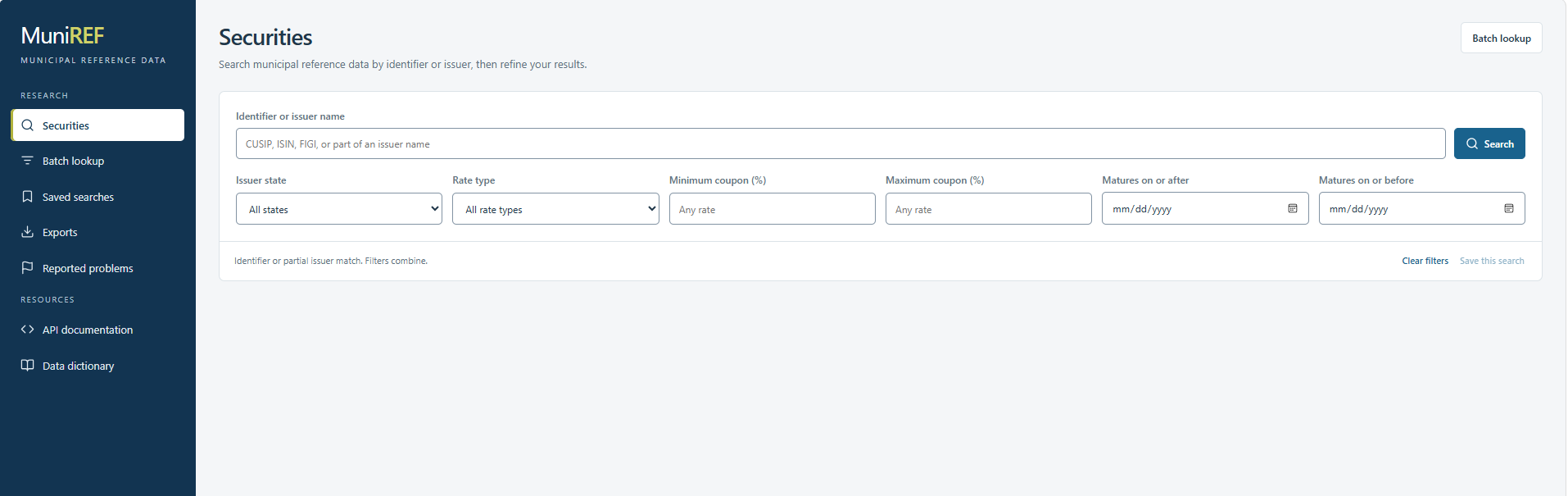
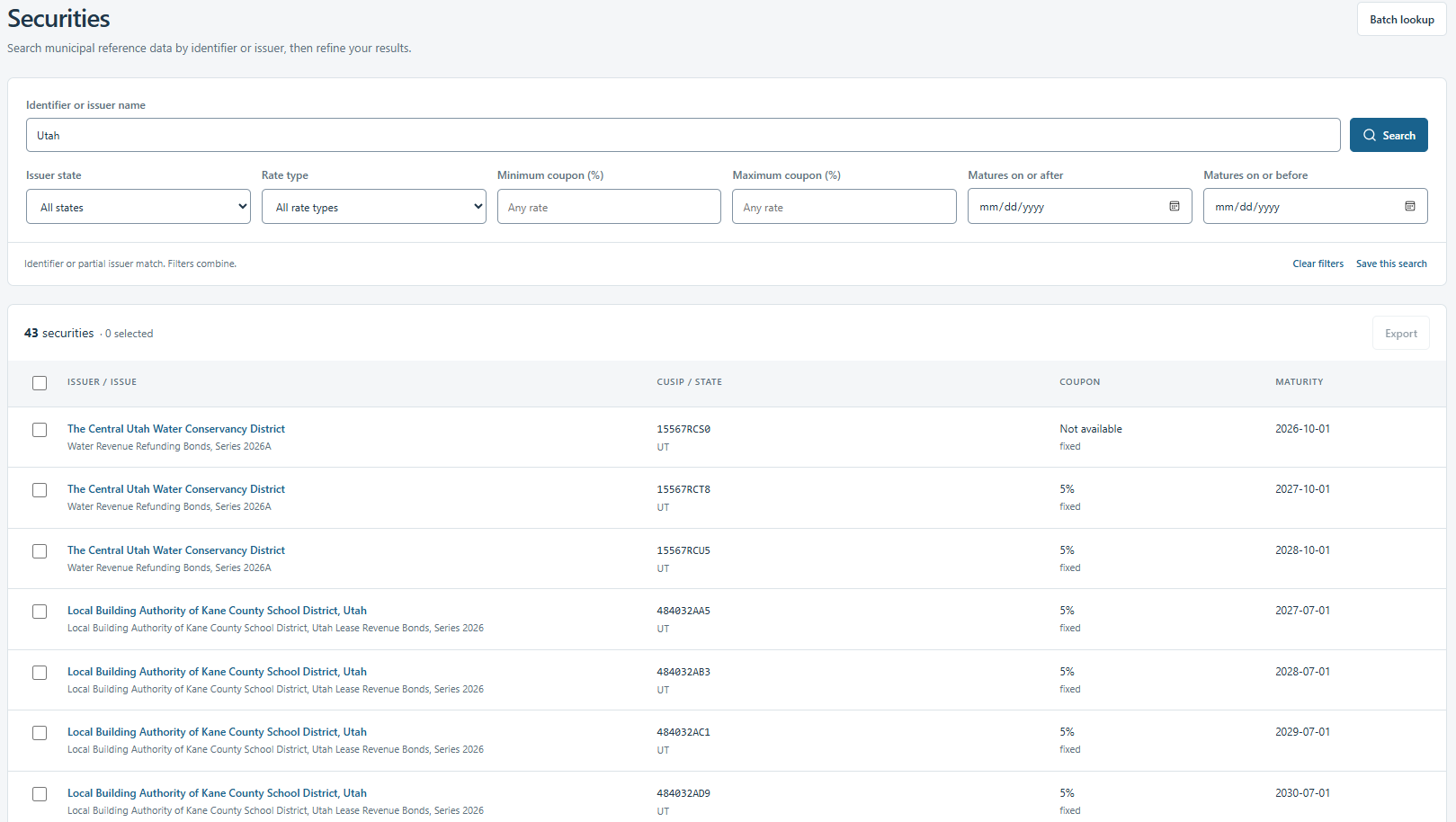
Click on the images below to view sample MuniREF screens.
See how MuniREF fits your data requirements
Whether you need a second source, a replacement, or a cost-effective source to fuel your startup, talk with DPC DATA about your requirements.
Let’s discuss your data requirements
Frequently Asked Questions
What is MuniREF?
MuniREF is a municipal reference data product from DPC DATA, developed in collaboration with FTLabs' DataLattice.ai. It is designed to convert municipal disclosure documents into validated, versioned data for security master databases, downstream systems, and AI workflows.
We already have a municipal reference data provider. Why consider MuniREF?
MuniREF can be evaluated as an independent second source, a validation feed, or a source for a particular workflow. You can also assess it as a replacement for your current data source. How you use it depends on your data requirements, current arrangements, and evaluation results. Users typically select MuniREF for its flexible delivery model and lower cost.
How can I be assured MuniREF data is accurate?
MuniREF is designed to extract information across documents, apply validation rules, and flag discrepancies for review. Our municipal data specialists examine exceptions that require judgment. Source references and correction records help our analysts investigate individual values.
Can MuniREF help us reduce data costs?
MuniREF’s automated production model is designed to reduce repetitive manual processing and, as a result, provide a cost-efficient sourcing option. Potential savings depend on your required coverage, service levels, delivery arrangements, and implementation effort.
A side-by-side review with your current provider can establish the economics for your organization.
How does MuniREF address errors in automated extraction?
Automated extraction is followed by data checks and exception review by humans. The process is designed to identify conflicting or questionable values for further examination.
MuniREF is powered by FTLabs’ DataLattice.ai an AI-driven document intelligence framework that transforms information embedded in complex, inconsistently formatted documents into structured, machine-readable data.
How will MuniREF integrate with our systems?
MuniREF can accommodate enterprise feeds and modern APIs, with options for receiving updated records. DPC DATA’s technical experts can review with you your required formats, schedules, controls, and implementation path, including which capabilities are available for your evaluation.
Can we trace data to its source and investigate corrections?
Source traceability, versioning, and correction controls are part of MuniREF’s design. Our municipal experts use this as a method for ensuring accuracy, while also helping to improve our data collection models.